In considering purchasing solar panels, your first question may be, “How many panels do I need?” Or “How much will they cost?” Unfortunately, there is no simple answer.
As with most complex questions, it is always best to start with the end in mind.
What is your goal in harnessing solar energy?
- Do you want to save as much money as you can immediately?
- Do you want maximum return on your investment over the longer term?
- Or do you want to minimise your carbon footprint?
Once you have answered those questions, you – or your professional installer – will need to understand what your average energy requirements are, that is, your usage in watts, and how it might vary, and the amount of sunlight you enjoy in your area. You will also need to consider the amount of roof space, and its orientation (south-facing or not), that you have available for the installation.
These, and other factors, will determine the number of panels you need or can fit, their physical size, type and efficiency, together with the rest of the configuration of your system – cabling, inverter, consumer unit, battery, diverter and so on.
TYPES OF PANELS
Solar panels are made up of lots of photovoltaic (PV) cells, which absorb energy in the form of photons, which in turn vibrate, generating green energy. This is known as the Photovoltaic effect.
The different types and brands of solar panels convert sunlight into energy with varying efficiency. These panels have different numbers of silicon cells, which determine the panel’s weight, size and cost. The power output of a panel is determined by two factors – its number of cells, and those cells’ efficiency.
There are three main types of cells – monocrystalline, polycrystalline and thin-film.
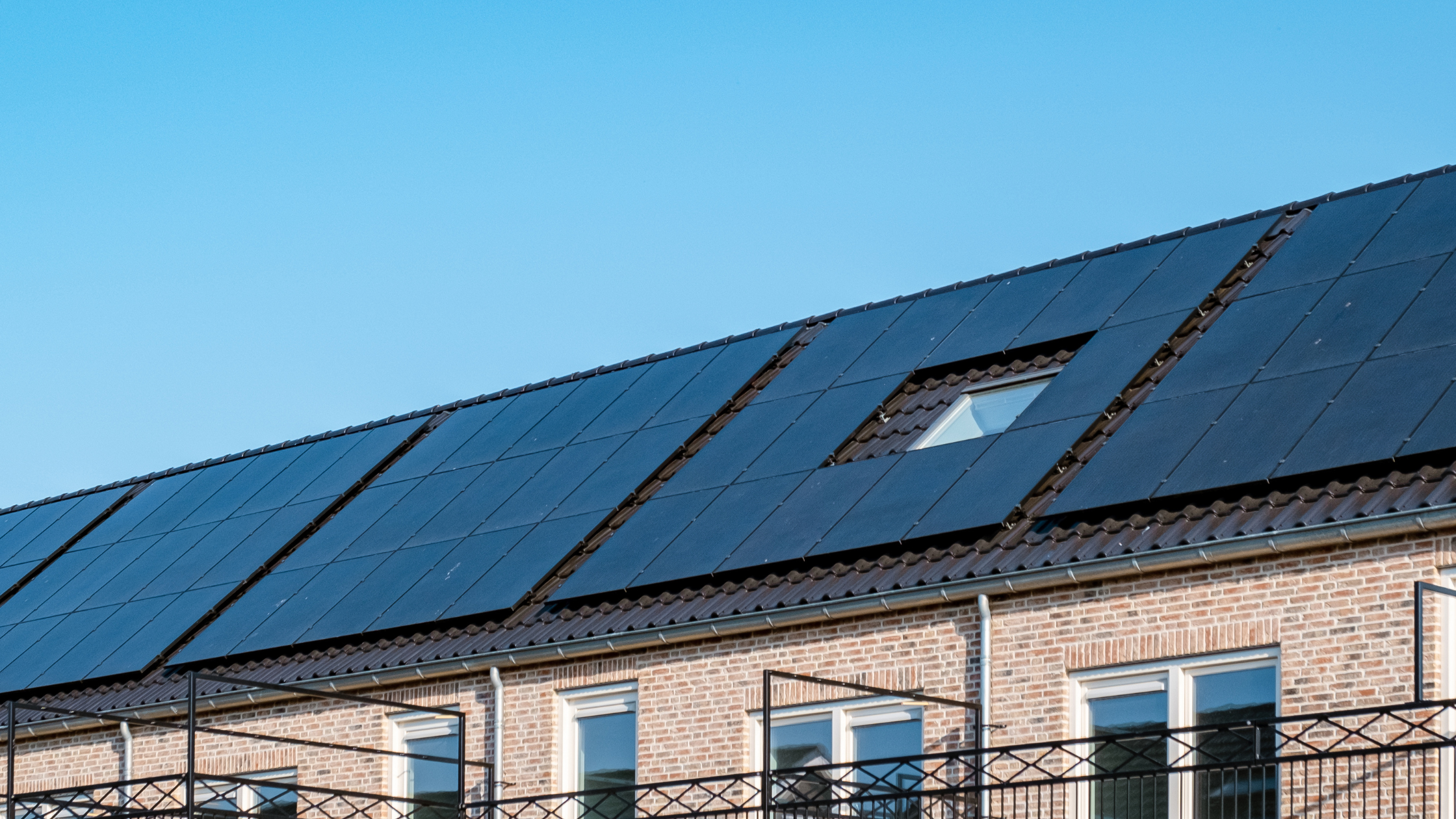
Monocrystalline panels are made from single crystal silicon cells. These are more expensive than others, but tend to last longer and be more efficient. They appear black and uniform, giving a more aesthetically pleasing look.
Polycrystalline cells are made from fragments of silicon crystal melted together. They are more affordable than the monocrystalline panels, but have a lower efficiency rating and do not last as long. (With more crystals in each cell, there is less room for the electrons to move.) Manufacturing is faster, cheaper and less wasteful than for monocrystalline. Polycrystalline cells appear blue and speckled.
Thin-film solar panels, unlike monocrystalline and polycrystalline solar panels, are thin, flexible and low in profile. This is because the cells within the panels are roughly 350 times thinner than the crystalline wafers used in monocrystalline and polycrystalline solar panels.
Thin-film solar panels consist of layers of materials like silicon, cadmium telluride and copper indium gallium selenide. They are less efficient than crystalline panels, requiring more roof space and degrading more quickly. Where the thin-film solution does score is in its flexibility, since it can be moulded into solar roof tiles or shingles, delivering solar energy without solar “panels” as such.
Deciding which panel is best comes down to application and budget. Polycrystalline is the most popular domestic solution, unless there is very limited space where the greater efficiency of the monocrystalline panels makes them possibly a better choice. Thin-film is only really used for larger commercial projects or for listed buildings, due to its light weight.
DIFFERENT SIZES, WATTAGE
Solar panels, as we have seen, vary in size and wattage, and you will need to work with your professional installer to calculate exactly what you need.
Panels tend to be between one and two metres in length and 0.8 to one metre in width, with an output ranging from 150 to 370 watts. To give you some idea of the average installation, a typical family of 3-4 people in the UK might require 16 250watt panels, producing the average 4kW output.
However, the final decision on your panel population will also be determined by other factors, such as your possible goal to store energy, and your type of roof.
ROOFS
Panels may be fixed “on roof” or “in roof.” “In roof” is where the panels take the place of tiles, forming the roof itself. In a new build, this naturally saves on the cost of those tiles and is considered more pleasing to the eye. “On roof” panels are fixed onto an existing roof. For this reason, “in roof” is most commonly seen in new developments. “In roof” is slightly less efficient than its alternative though, as the panels in the roof find it more difficult to breathe and therefore generate 5-10% less energy. GSE Integration (Groupe Solution Energie) is the most popular in-roof solution.
ON-ROOF FIXING SYSTEMS
In on-roof systems, generally speaking, installers temporarily remove tiles on your roof to fix the brackets. Rails are then attached to the brackets, the panels sit on top of the rails and are secured in place with clamps.
FLAT ROOF SYSTEMS
If you have a flat roof, it is certainly possible – and fairly straightforward – to harness solar energy. There are generally two main solutions – ballast pods and A-frames.
Ballast pods look like large wedges, where the panel is fixed to the wedge (giving it its angle) and ballast is loaded to secure it in place. The amount of ballast (weight) needed – an average of 90kg – makes this unsuitable for many roofs.
A-frames, on the other hand, are stainless steel or aluminium frames that fix directly to the roof. They are lightweight, around 25kg including the panel. However, since the fixings need to penetrate a flat roof, special weathering capped screws and an additional timber upstand are required, meaning the final profile would be a timber deck, roof covering (felt), timber fixing points for the solar panels, then the additional covering and finally the capped screws.
With flat roof installations, it is obviously important that the front row of panels does not shade the second, etc.! There may also be a planning issue here, since, unlike with pitched roof solutions, you are raising the height of the roof.
BIRD PROTECTION
Birds and particularly pigeons can cause huge damage to solar installations. Unfortunately, your average solar panel creates an ideal spot for pigeons to nest and breed. Apart from the noise and the mess that they will bring, their presence will also compromise the performance of your panels.
But there are solutions, and these include the use of metal or PVC mesh, spikes, netting, proprietary solar panels skirting and specialist bird blockers.
ROOF ACCESS – SCAFFOLDING
Unless your home is single storey, then it is very likely that scaffolding will be required for the installation of your solar panels. This will be a fully-boarded platform erected along the length of the gutter, a little wider than the width of the intended panels. There will also be “edge protection” on the roof on each side of the scaffolding platform, for the safety of the installers.
ELECTRICAL CONSIDERATIONS
INVERTER
An inverter is a crucial part of your solar energy system, since it converts the direct current (DC) electricity generated by the panels, to alternating current (AC), which is what your home appliances and the grid needs.
Inverters come in different sizes, rated in watts, like your panels. Your inverter needs to be able to handle all of the energy your solar array produces. So, in general, if you have a system that generates 3,000 watts, you’ll need a 3,000-watt inverter at least.
BATTERY
A hybrid inverter can convert DC to AC for your appliances and the grid AND pass DC current to a battery for later use. As many of us are not at home during the daytime (the period when the solar panels are generating energy of course), only a percentage of the energy generated then will be used immediately for fridges, etc..
Having a battery means you can store that energy for your later use or to pass on to the grid. This also delivers other benefits, allowing you access to electricity during a power cut, and enabling you to buy cheap energy during off-peak hours, to be stored in the battery, to use during peak-cost times.
There are regulations around the positioning of batteries, and most will be put in the garage – away from the outside environmental onslaughts, which may degrade the battery’s performance, but also away from your family’s habitable areas.
CONVERTER, CONTROLLER, INVERTER
There is some confusion around these terms. An inverter changes DC to AC. A controller or converter is DC to DC, controlling the flow of power between panels and the battery, making it consistent.
CONSUMER UNIT
The consumer unit receives AC power from the inverter and controls the distribution of the energy throughout the property. It will also decide when to take energy from the grid or when to utilise the energy stored in your battery system.
CABLING
In general, the longer the cabling between the solar panels and the inverter and battery, the greater the likelihood of a drop in efficiency. A maximum of 6 to 10 metres is recommended. The cabling from the inverter to battery should be no more than 3 metres.
HOT WATER DIVERTER
Hot Water Diverters are also known as immersion diverters, energy diverters and other names. This is because they divert surplus energy to heat your water. With the cost of energy being far greater than anything a household might make passing power back to the grid, it makes sense to use as much as possible in your own property. Hot water diverters allow you to do just that.
As you can see, specifying your solar energy system involves a lot more than, “How many panels do I need?”! There are so many different factors to bear in mind that it is vital to seek professional guidance. A good installer will be happy to give you a provisional quote based on a fairly detailed telephone conversation and a Google Street View look at your property. This will give them most of the information they need to understand your property, your usage and your ambitions for your solar energy system.