If you live in the UK, chances are you’ve asked yourself this question at least once: do solar panels actually work on cloudy days? With our famously grey skies, it’s a fair concern - and one of the biggest myths holding homeowners back from renewable energy.
The short answer is yes. Solar panels work on cloudy days, and they work surprisingly well in UK conditions. To understand why, it helps to look at how solar panels really generate electricity.
How Do Solar Panels Work on Cloudy Days?
Let’s break this down in simple terms.
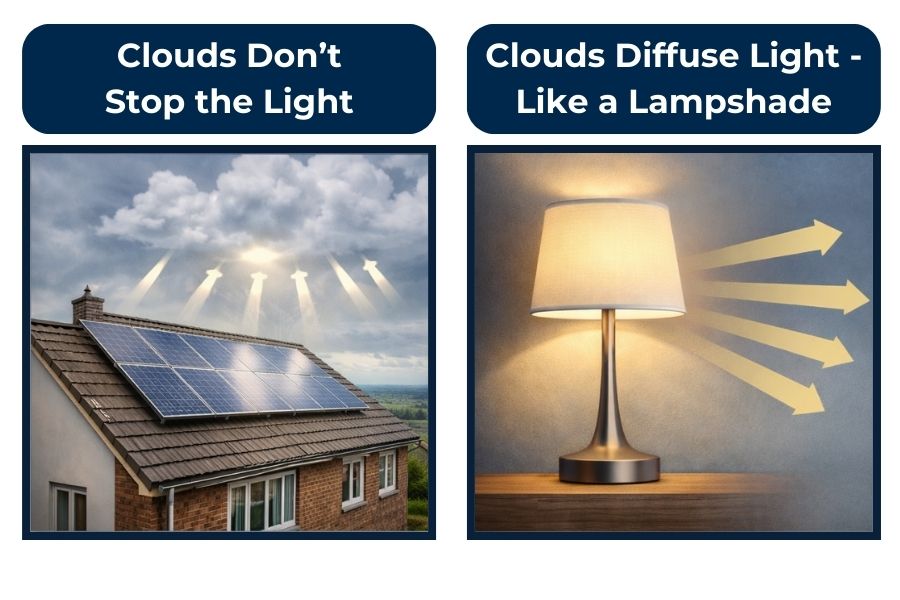
Solar panels don’t actually need direct sunshine to work - they need light. When clouds cover the sun, they don’t block all sunlight completely. Instead, they scatter it in different directions.
A good way to picture this is with a lampshade.
When you put a lampshade over a bulb, the light doesn’t disappear - it spreads softly around the room rather than shining in one harsh beam. Clouds do the same thing with sunlight. Even on an overcast day, plenty of usable light still reaches your roof.
That scattered light is known as diffuse radiation, and modern solar panels are very good at capturing it.
How Much Power Do Solar Panels Produce on Cloudy Days?
On cloudy days, solar panels usually produce around 10% to 25% of what they would on a bright, sunny day. While that might sound low, the key thing to remember is that they never stop working. Even under heavy cloud, your system is still generating electricity for daytime use, helping cut how much power you need from the grid and lowering your energy bills over time.
As Tom Meredith, EVR Electrician and Solar PV Designer, explains, solar panels generate electricity by capturing photons from sunlight, which are still present in cloudy UK weather - just in lower concentrations. In heavy cloud cover, efficiency can fall to around 10-20%, while in lighter or broken cloud conditions, panels can still operate at 60-80% efficiency. He also points out that partially cloudy weather can briefly boost output due to the edge effect, where sunlight reflects off the edges of clouds and increases the amount of solar radiation reaching the panels. This is why solar performance in the UK is dynamic rather than predictable day to day, and why modern PV systems are designed to make the most of changing light conditions throughout the year.
Why Modern Solar Panels Perform Better Than You Expect
Solar technology has come a long way in the last decade. Today’s panels are designed to work efficiently in low-light conditions, which makes them particularly well-suited to the UK climate.
Modern photovoltaic cells can capture a wider range of light wavelengths. When clouds filter out parts of the sun’s rays, panels don’t just “switch off” - they continue converting whatever light makes it through into usable electricity.
Cooler Weather Can Actually Improve Efficiency
Here’s a fact that surprises many homeowners: solar panels don’t like extreme heat.
As temperatures rise, panel efficiency drops slightly. This means that on very hot summer days, panels can lose some of their potential output. In contrast, the cooler temperatures that often come with cloudy UK weather help panels operate closer to their optimal range.
So while there may be less light on a cloudy day, the panels themselves are often working more efficiently. In many cases, this helps offset part of the reduction in sunlight - nature’s way of balancing things out.
Why the UK Climate is Better for Solar Than You Think
The UK’s climate actually supports solar performance in several key ways:
- long daylight hours in spring and summer
- efficient low-light performance in autumn and winter
- cooler average temperatures year-round
- consistent background generation, even on cloudy days.
Cloudy skies don’t stop solar panels from working; they simply change how they work. Thanks to modern technology and effective diffuse light capture, solar panels remain productive throughout the year, proving solar energy is a reliable and effective renewable solution in the UK - even under grey skies.
Your Next Steps with EVR
Modern solar systems perform exceptionally well in UK conditions. Our extensive performance data, combined with thousands of satisfied customers, demonstrates that solar energy is not just viable in our climate - it’s highly beneficial.
The first step is understanding your property’s solar potential. Our engineering team provides detailed site assessments that consider your roof’s orientation, local shading, historical weather patterns and energy usage. This comprehensive analysis ensures accurate projections and optimal system design.
EVR Business Development Manager, Tim Morton, concludes: “Our regional expertise ensures every installation is optimised for local conditions. We’re so confident in our systems that we guarantee performance levels - and we consistently exceed them.”
If cloudy skies have been holding you back, now is the time to take a closer look. Contact our team today to discover what solar could deliver for your property - all year round, whatever the weather.